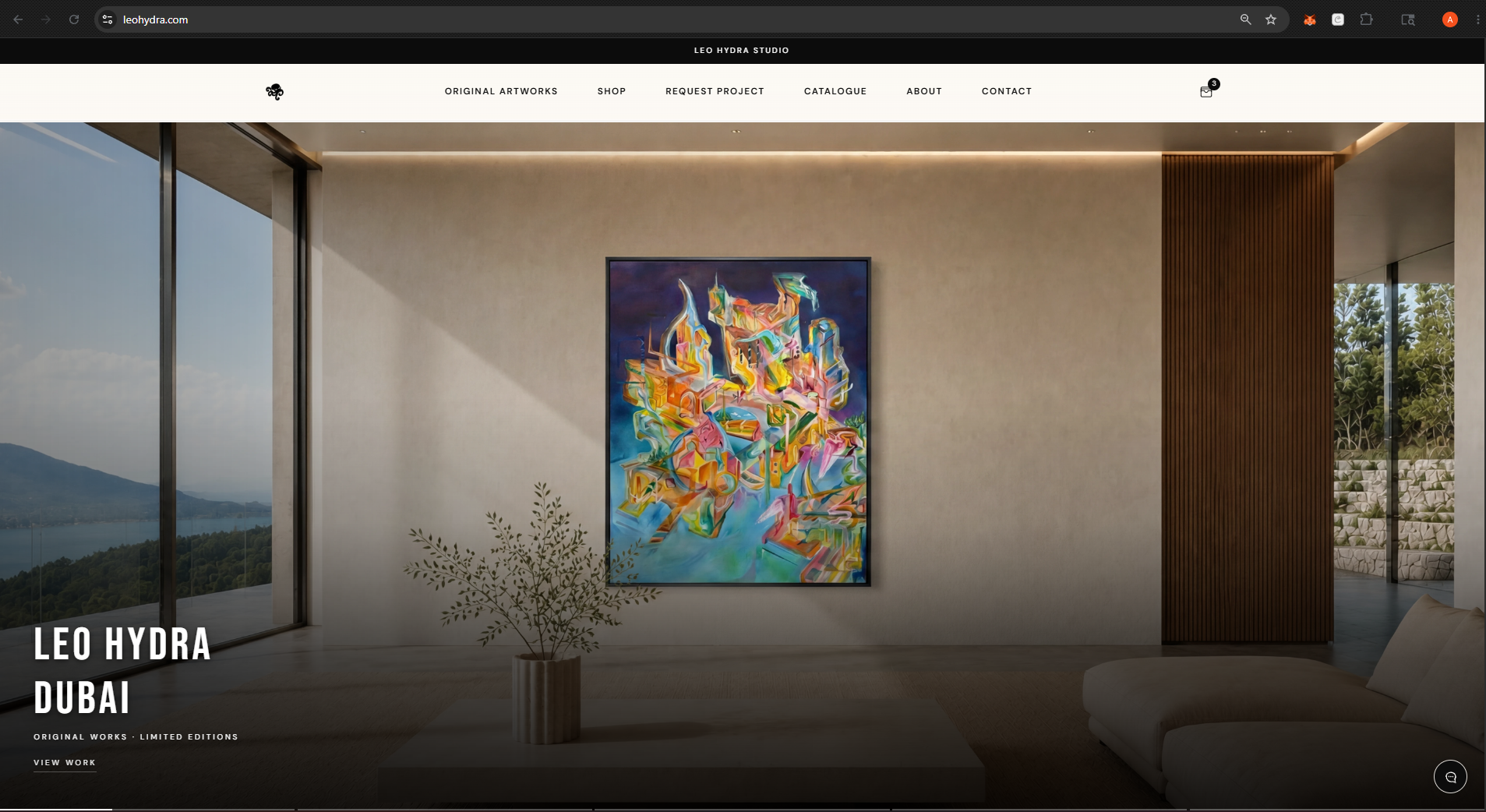
No template, no inherited codebase. The artist makes the work in Dubai. I design, code, and ship everything else from Mumbai. Live at leohydra.com.
Scale today
Each drop is six new print designs, edition of 50 each, 300 prints in total. They clear inside 7 days of going live. Originals don't ship through this funnel at all: they're priced on inquiry, handled one at a time, and roughly one moves a month.
What I built
A production-grade Next.js 14 e-commerce platform that I architected and wrote from scratch:
- Dual-rail checkout: USDT-on-Polygon (verified on-chain via
ethersplus a Vercel Cron scanner walking USDT Transfer events every ~2 minutes) and bank transfer (admin manual confirm, UTR uniqueness enforced at the DB via partial unique index). - Micro-offset payment discriminator: every crypto order gets a unique 1 to 999 µUSDT offset added to its expected amount, enforced by a partial unique index on
payments(expected_amount_micro) WHERE status='initiated'. Two pending orders with identical cart totals can never collide on-chain. Reserved and released by status-change triggers. - Race-locked payment confirmation:
confirm_payment_atomicdoesSELECT … FOR UPDATEon the order row at the very top, then status-guardedUPDATEs to serialize against admin-cancel, auto-expire, and cron-expire (migration 031). Three cascading triggers onordershandle payment-row expiry, stock release, and micro-offset release in lockstep. - Transactional email pipeline: Resend-backed sends across six lifecycle email kinds (order confirmation, bank instructions, bank reference submitted, bank confirmed, order recovery, studio notifications). Every send writes a row to an append-only
order_email_eventsaudit table. Admin "Resend" UI is synced with the API route mapping so what's offered and what's sent stay in sync. - Meta Pixel + Conversions API across every conversion surface (checkout, inquiry / contact / project-request forms, newsletter, product pages, site-wide PageView), all dedup-aware via a shared
eventID, PII hashed SHA-256 per Meta spec. Browser PageView usesnavigator.sendBeaconwith afetchkeepalivefallback.
One order, end to end
What it actually looks like when someone buys a print. A real $199 Chromatic print order, paid in USDT on Polygon, walked across every system I built. Auto-plays; hover to pause; click any step to jump.
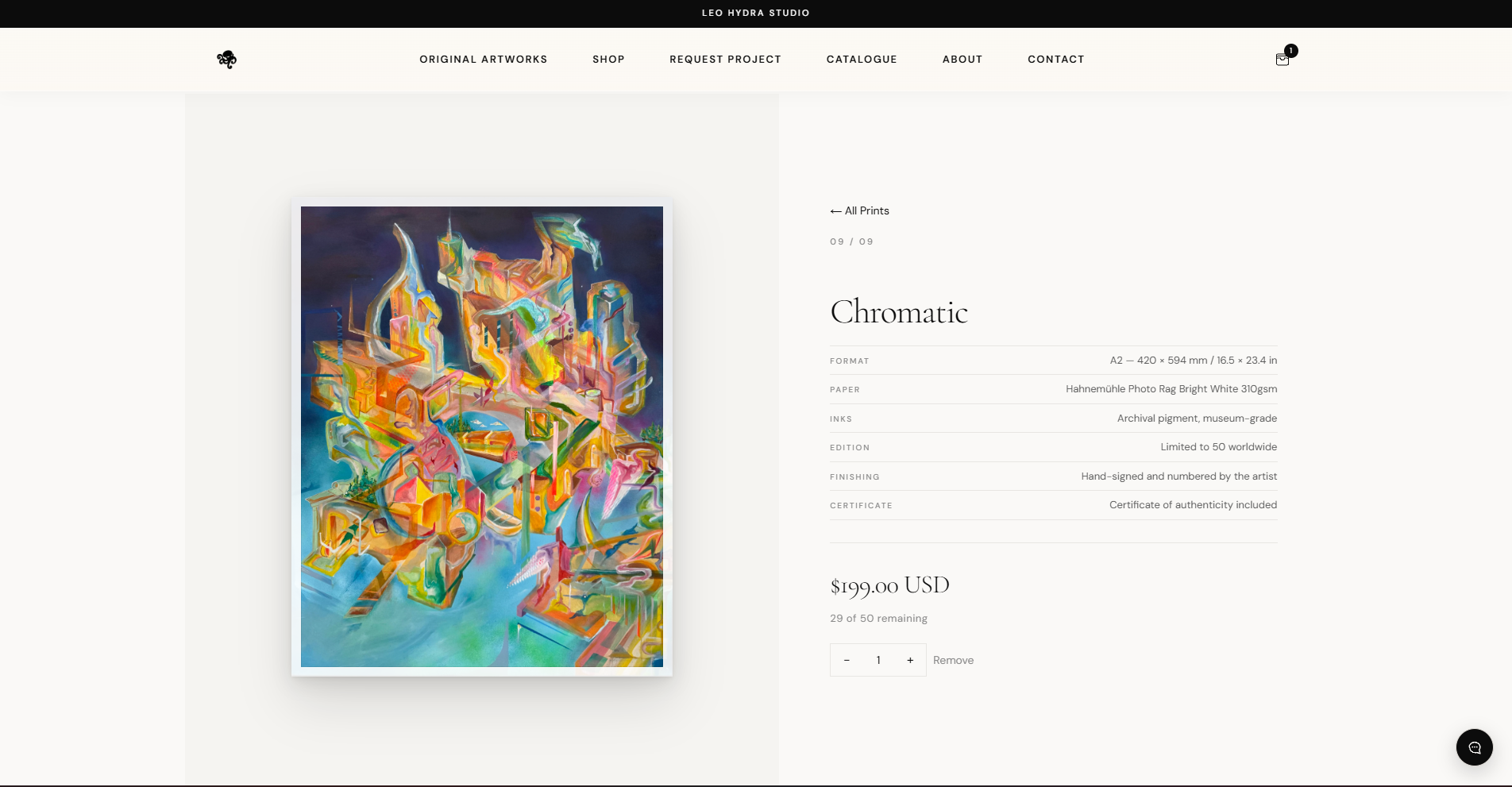
Reader lands on the print page. $199, edition of 50, 29 remaining. Every state (preorder, available, fully collected) is its own variant of this same UI.
Swipe to navigate
Engineering scale
The full breakdown: 12 Postgres tables (orders, order_items, payments, bank_transfer_payments, crypto_payments, products, leads, newsletter_subscribers, order_email_events, payment_micro_reserved, order_scan_throttle, rate_limit_buckets). 30 forward-only migrations applied via Supabase SQL editor, with verified live-DB drift checks against nightly pg_dump backups. Three rounds of self-led adversarial code review hardened rate limiting, brute-force lockout, CSRF Origin checks, PII redaction, three isolated HMAC secrets, and CSP + security headers in next.config.js.
The actual database schema, interactive. Drag tables around, pinch or scroll to zoom, click the minimap to jump, hit "Reset layout" to restore. The seven FK relationships between orders, order_items, payments, crypto_payments, bank_transfer_payments, order_email_events, order_scan_throttle, and products are drawn as animated edges. The four standalone tables (leads, newsletter_subscribers, rate_limit_buckets, payment_micro_reserved) sit independently. They belong to inquiry, marketing, infrastructure, and crypto discriminator subsystems respectively. None of them need referential ties to the order graph.
A separate commerce model for originals
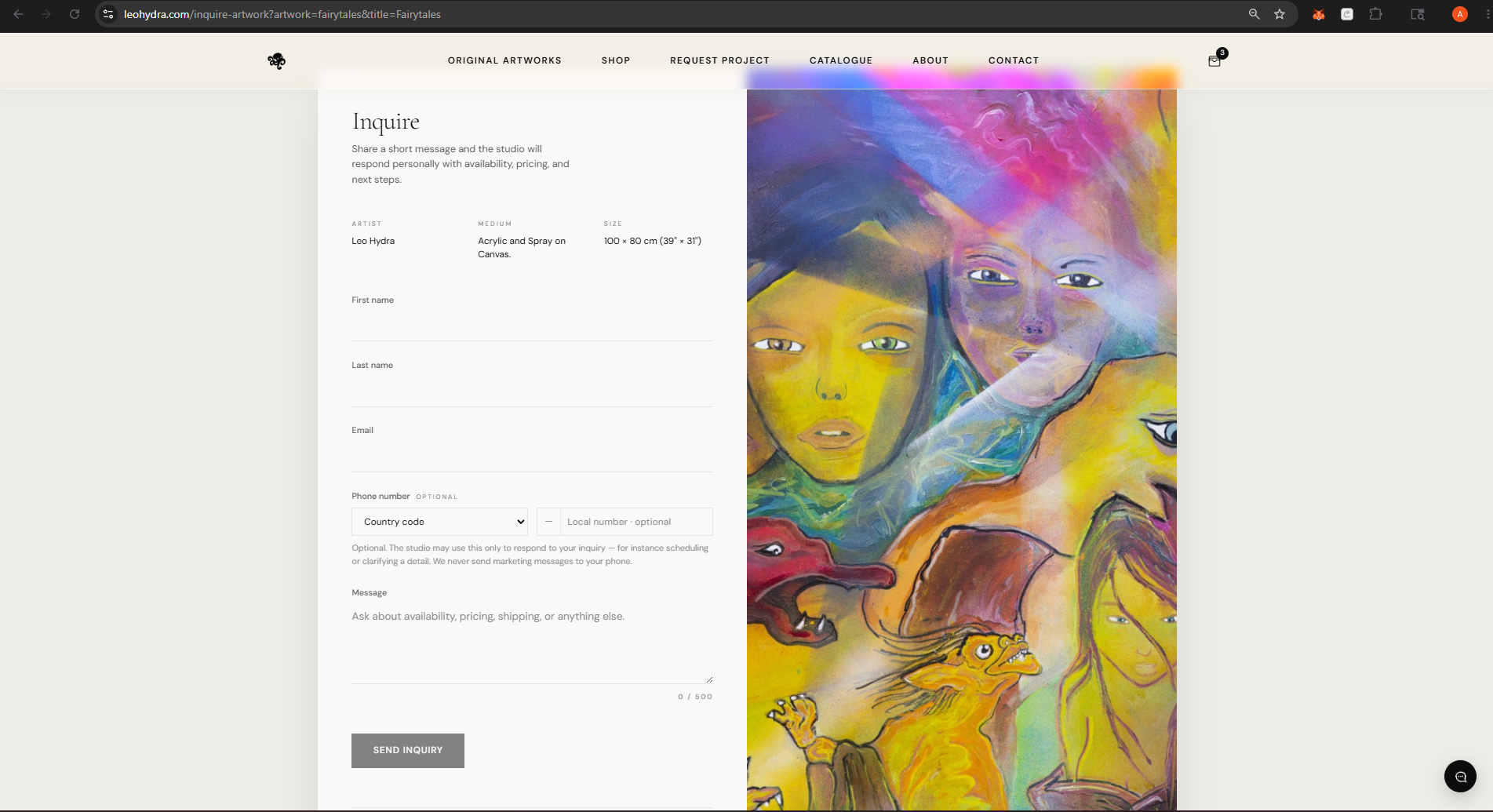
Originals don't run through the checkout above. Unique pieces are priced on inquiry, captured into the leads table, and routed to the studio manually. Two commerce models, one codebase.
“Arnav handles everything technical at Leo Hydra. Site, payments, emails, admin panel, the whole damn thing. We've been live and selling since October 2025 and I haven't touched a line of code. I make the work, he ships it.”
The non-code half
I run the Meta ad campaigns end to end. I work with printing houses on every limited-edition production run, coordinate fulfilment out of the Dubai warehouse, hire and direct video editors, handle sound design, and post across Behance, Tumblr, and Instagram.
Live at leohydra.com.